Field note · 31 July 2026
What you need to print jerseys at your event
Nearly every problem a live jersey station has on the day was solvable four weeks earlier with an email. This is the list of things worth sorting early, in the order they tend to bite.
1. Power, before anything else
Heat presses draw real current. Plan a dedicated 20A circuit per lane. The failure mode is not subtle: two presses sharing a household circuit will trip a breaker under load, usually at your busiest moment, and the recovery costs you the queue you had built.
At a venue with a house electrician, this is a five-minute conversation. At a show floor, it is an advance power order with a deadline weeks out and punishing on-site rates if you miss it. At an outdoor build, it is a generator sized with headroom rather than to the nameplate. Ask us for the power sheet and forward it straight to whoever owns the venue relationship.
2. Floor space, and the shape of it
Two lanes plus intake and pickup is comfortable in roughly a 10x10 if the counter runs along the guest side. Three or four lanes want a 10x20 or an L-shaped corner. Square footage matters less than flow: guests approach intake, step sideways, and collect at a separate point. If the guest path crosses the crew path, throughput drops and so does safety — presses are hot and people are distracted.
Also plan where the queue physically stands. Indoors that is usually an aisle-encroachment question. Outdoors it is a sun and shade question. Both are easier to answer on a drawing than on the day.
3. Garments and the size curve
Decide early whether you are supplying jerseys or we are sourcing blanks, because it changes the whole shape of the quote. If we are sourcing, Augusta Sportswear and Badger cover most blank jersey needs across adult XS–3XL. Build the curve against your actual audience, not an athletic ideal — corporate and family crowds run larger than planners expect, and running out of XL two hours in reads as poor planning no matter how many jerseys you gave away.
If you are supplying, send a sample from the real production run for press testing. Sublimated panels and coated fabrics behave differently than the spec sheet suggests.
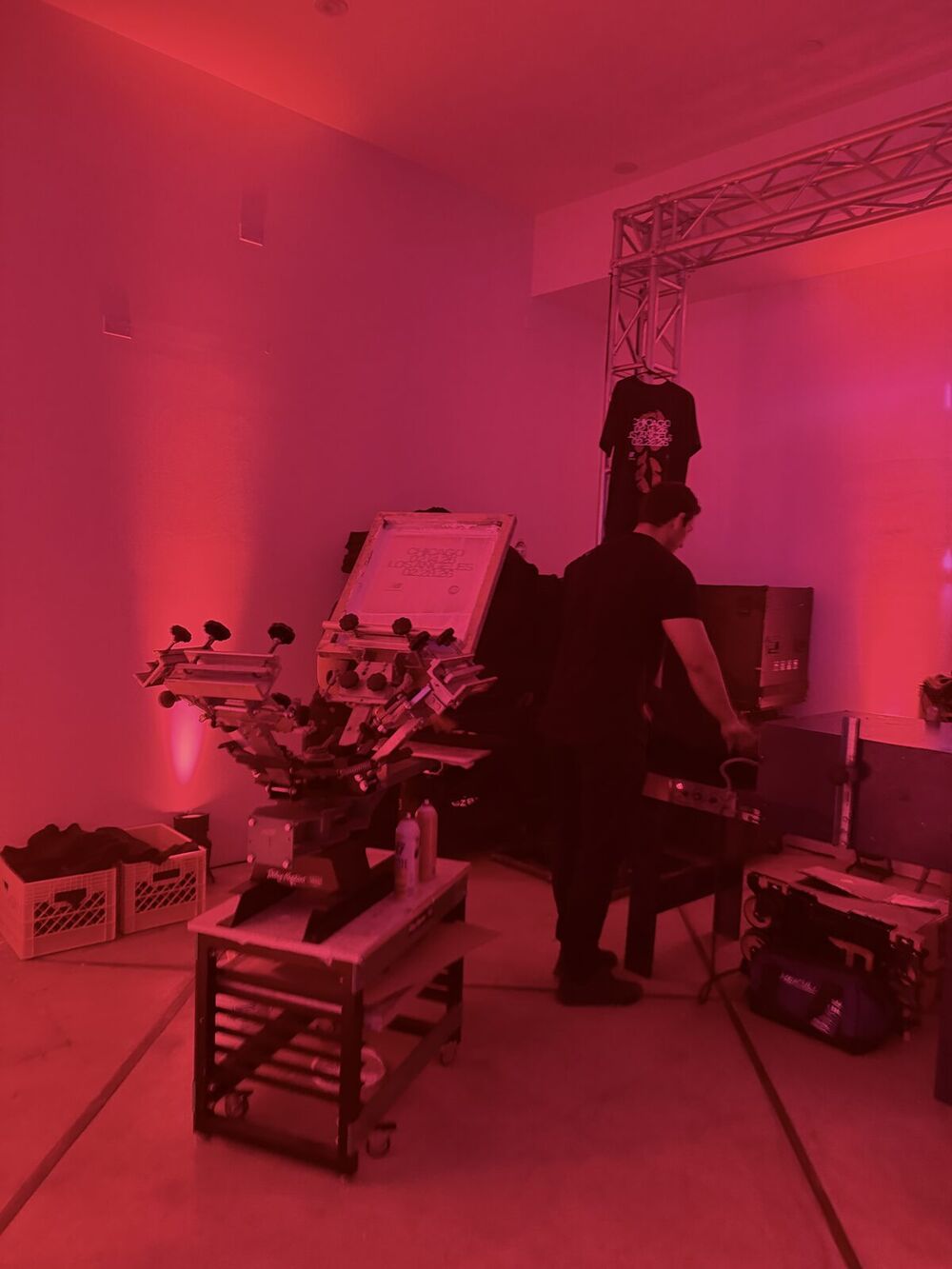
4. Art files, prepped not improvised
Sponsor marks, crests and the numeral face all need to be settled and proofed before load-in. Vector art, sent early. If a color has to match a brand standard, say so in writing rather than assuming the screen you approved it on matches ours.
The numeral is worth an actual design decision. A custom varsity face with an outline photographs far better than a default block number, and once the art is prepped it costs nothing extra to use it on every jersey that day.
5. Names, if you have them
Any list of names known in advance — a roster, an RSVP list, a VIP list — is worth sending. Those get gang-printed onto transfer sheets and sorted before the event, which turns each one into a pick-and-press on the day rather than a produce-and-press. It is the single cheapest throughput improvement available.
Expect a flag list back: names over the nine-character practical cap, duplicate numbers, accents that need confirming. Those are your decisions, and making them on a spreadsheet is much better than making them at a press with a guest waiting.
6. The run of show
Not a headcount. The actual schedule. Doors, keynote breaks, kickoff, the moment a session lets out and dumps four hundred people into your footprint. Lane count should be built against the peaks, and a station sized for the average will be visibly underwater during the hour everyone photographs.
7. The venue's paperwork
Exhibitor kits, load-in windows, labor rules, fire-lane requirements, insurance certificates. Every one of these is trivial with notice and expensive without. Forward the packet with your brief and we will read it.
Start the list
Send hours, venue, jersey target and garment source and we will send back the power and space sheet plus lane math. Send the brief · Line setup detail